Saturday, 14 October 2017

Atul Auto Ltd Buy

Atul Auto Ltd Buy


Atul Auto Ltd., incorporated in the year 1986, is a Small Cap company (having a market cap of Rs 1045.98 Crore) operating in Auto sector.

Atul Auto Ltd. key Products/Revenue Segments include Automobile - 3 Wheelers which contributed Rs 456.76 Crore to Sales Value (96.09 % of Total Sales), Spare Parts & Others which contributed Rs 15.40 Crore to Sales Value (3.24 % of Total Sales), Other Operating Revenue which contributed Rs 3.13 Crore to Sales Value (0.65 % of Total Sales) and Traded Goods which contributed Rs .04 Crore to Sales Value (0.00 % of Total Sales)for the year ending 31-Mar-2017.

For the quarter ended 30-06-2017, the company has reported a Standalone sale of Rs 115.53 Crore, up 11.86 % from last quarter Sales of Rs 103.28 Crore and up 24.96 % from last year same quarter Sales of Rs 92.45 Crore Company has reported a net profit after tax of Rs 7.81 Crore in latest quarter.

The company’s top management includes CA.Hemantkumar J Bhatt, Dr.Margie S Parikh, Dr.Vijay K Kedia, Mr.Hakubhai J Lalakiya, Mr.Hasmukh H Adhvaryoo, Mr.Jayantibhai J Chandra, Mr.Mahendrakumar J Patel, Mr.Niraj J Chandra. The company has Maharishi & Co as its auditors As on 30-09-2017, the company has a total of 21,943,200 shares outstanding.

Courtesy see more @ http://bit.ly/2yn5KfH


Return on Capital Employed (ROCE)

Return on Capital Employed (ROCE)


The Return on Capital employed indicates the profitability of the company taking into consideration
the overall capital it employs.

Overall capital includes both equity and debt (both long term and short term).

ROCE = [Profit before Interest & Taxes / Overall Capital Employed]
Overall Capital Employed = Short term Debt + Long term Debt + Equity

From ARBL’s Annual Report we know:

Profit before Interest & Taxes = Rs.537.7 Crs

Overall Capital Employed:

Short term debt: Rs.8.3 Crs
Long term borrowing: Rs.75.9 Crs
Shareholders equity = Rs.1362 Crs
Overall capital employed: 8.3 + 75.9 + 1362 = 1446.2 Crs
ROCE = 537.7 / 1446.2 = 37.18%


Friday, 13 October 2017

Financial Ratio - Return On Asserts

Financial Ratio - Return On Asserts


The Return on Equity (ROE) is a very important ratio, as it helps the investor assess the return the shareholder earns for every unit of capital invested. RoE measures the entity’s ability to generate profits from the shareholder's investments. In other words, RoE shows the efficiency of the company in terms of generating profits to its shareholders. Obviously, higher the RoE, the better it is for the shareholders. In fact, this is one of the key ratios that help the investor identify investable attributes of the company. To give you a perspective, the average RoE of top Indian companies vary between 14 – 16%. I personally prefer to invest in companies that have a RoE of 18% upwards.

This ratio is compared with the other companies in the same industry and is also observed over time.Also note, if the RoE is high, it means a good amount of cash is being generated by the company, hence the need for external funds is less. Thus a higher ROE indicates a higher level of management performance.

RoA = [Net income + interest*(1-tax rate)] / Total Average Assets
From the Annual Report, we know:

Net income for FY 14 = Rs.367.4 Crs

And we know from the Dupont Model the Total average assets (for FY13 and FY14) = Rs.1955 Crs So what does interest *(1- tax rate) mean? Well, think about it, the loan taken by the company is also used to finance the assets which in turn is used to generate profits. So in a sense, the debt holders (entities who have given a loan to the company) are also a part of the company. From this perspective, the interest paid out also belongs to a stakeholder of the company. Also, the company benefits in terms of paying lesser taxes when interest is paid out, this is called a ‘tax shield’.For these reasons, we need to add interest (by accounting for the tax shield) while calculating the
ROA.

The Interest amount (finance cost) is Rs.1 Cars, accounting for the tax shield it would be = 7* (1 – 32%)= 4.76 Crs. Please note, 32% is the average tax rate.

Hence ROA would be – ROA = [367.4 + 4.76] / 1955 ~ 372.16/ 1955 ~19.03%


Return on Equity (RoE)

Return on Equity (ROE)


The Return on Equity (ROE) is a very important ratio, as it helps the investor assess the return the shareholder earns for every unit of capital invested. ROE measures the entity’s ability to generate profits from the shareholder's investments. In other words, RoE shows the efficiency of the company in terms of generating profits to its shareholders. Obviously, higher the RoE, the better it is for the shareholders. In fact, this is one of the key ratios that help the investor identify investable attributes of the company. To give you a perspective, the average RoE of top Indian companies vary between 14 – 16%. I personally prefer to invest in companies that have a RoE of 18% upwards.
This ratio is compared with the other companies in the same industry and is also observed over time.

Also note, if the RoE is high, it means a good amount of cash is being generated by the company, hence the need for external funds is less. Thus a higher ROE indicates a higher level of management performance.

RoE can be calculated as: [Net Profit / Shareholders Equity* 100]

There is no doubt that RoE is an important ratio to calculate, but like any other financial ratios, it also has a few drawbacks. To help you understand its drawbacks, consider this hypothetical example.Assume Vishal runs a Pizza store. To bake pizza’s Vishal needs an oven which costs him Rs.10,000/-. The oven is an asset to Vishal’s business. He procures the oven from his own funds and seeks no external debt. At this stage, you would agree on his balance sheet he has a shareholder equity of Rs.10,000 and assets equivalent to Rs.10,000.

Now, assume in his first year of operation, Vishal generates a profit of Rs.2500/-. 

What is his RoE?

This is quite simple to compute: RoE = 2500/10000*100 =25.0%.

Low Cost Stock Broker


GODERJ AGROVET LIMITED

GODERJ AGROVET LIMITED


Godrej Agrovet IPO subscribed 2.37 times on Day 2 

NEW DELHI: The Rs 1,157-crore initial public offer (IPO) of Godrej Agrovet (GAVL) was subscribed 2.37 times on day two of the bidding process on Thursday. 

The public offer received bids for 4,19,93,536 shares against 1,80,27,464 shares offered by the company, according to data available with NSE until 5 pm. 

The offer had been subscribed over 52 percent on the first day of the bidding process on Wednesday. 

On Tuesday, the company allotted 74.17 lakh shares to 25 anchor investors including Reliance capitalize -0.54 % Trustee Company, SBI Life Insurance Company, Nomura, Goldman Sachs, Government of Singapore, among others, at Rs 460 apiece. 

Godrej IndustriesBSE 1.03 % owns 60.81 percent stake in Godrej Agrovet and intends to use the IPO proceeds towards loan repayments and other general purposes. 

The company is the largest palm oil producer in India. Its joint venture in Bangladesh is the fourth largest feed producer in terms of sales volume. 

courtesy see more @ http://bit.ly/2xD0Szq


Financial Ratios


Financial Ratios


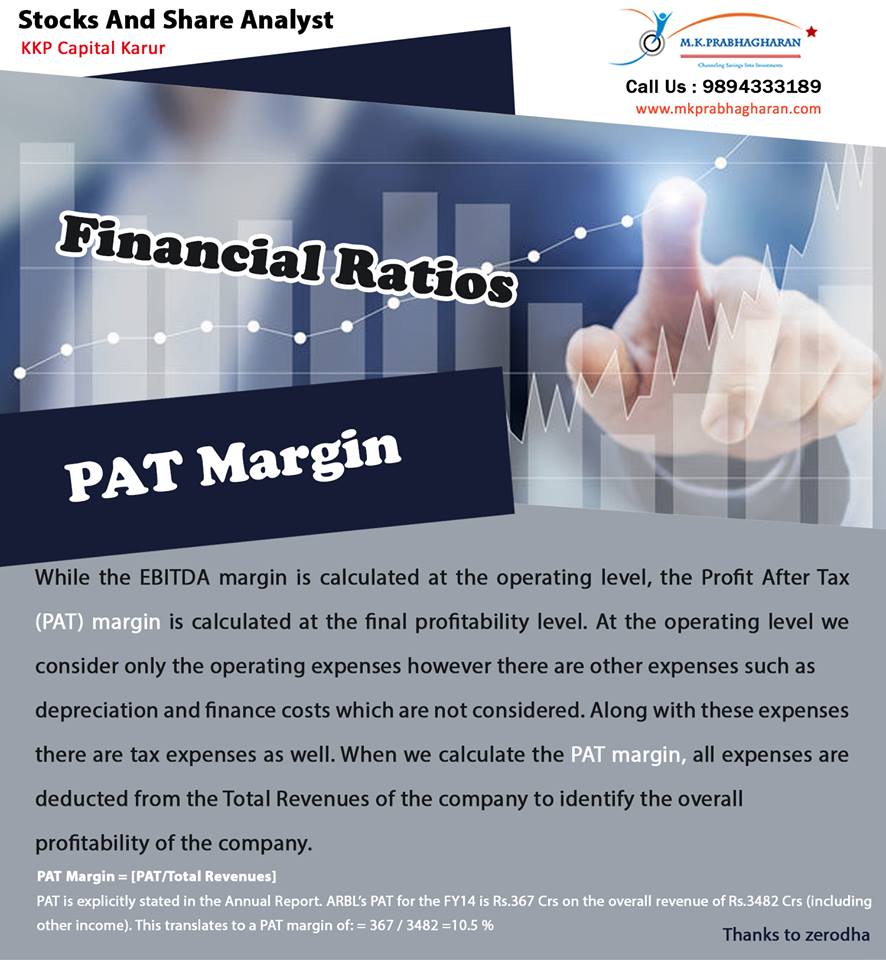
PAT Margin

While the EBITDA margin is calculated at the operating level, the Profit After Tax (PAT) margin is calculated at the final profitability level. At the operating level, we consider only the operating expenses, however, there are other expenses such as depreciation and finance costs which are not considered. Along with these expenses, there are tax expenses as well. When we calculate the PAT margin, all expenses are deducted from the Total Revenues of the company to identify the overall profitability of the company.

=10.5 %

PAT Margin = [PAT/Total Revenues]
PAT is explicitly stated in the Annual Report. ARBL’s PAT for the FY14 is Rs.367 Crs on the overall revenue of Rs.3482 Crs (including other income). 

This translates to a PAT margin of: = 367 / 3482 =10.5 %


Wednesday, 11 October 2017

What You Need To Get Started With Mutual Fund Investing?

What You Need To Get Started With Mutual Fund Investing?


To start investing in a fund scheme you need a PAN, bank account and be KYC (know your client) compliant. The bank account  should be in the name of the investor with the Magnetic Ink Character Recognition (MICR) and Indian Financial System Code  (IFSC) details. These details are mentioned on every cheque leaf and it is common for an agent or distributor to seek a  cancelled bank cheque leaf.

How to get your KYC?

The need for KYC is to comply with the market regulator SEBI in accordance with the Prevention of Money laundering Act, 2002  ('PMLA'), which undergo changes from time to time.

KYC process is investor friendly and is uniform across various SEBI regulated intermediaries in the securities market such as  Mutual Funds, Portfolio Managers, Depository Participants, Stock Brokers, Venture Capital Funds, Collective Investment  Schemes and others. This way, a single KYC eliminates duplication of the KYC process across these intermediaries and makes  investing more investor friendly.

Documents required to be submitted along with KYC application

*Recent passport size photograph
*Proof of identity such as a copy of PAN card or UID (Aadhaar) or passport or voter ID or driving licence
*Proof of address passport or driving license or ration card or registered lease/sale agreement of residence or latest bank  A/C 

You will need to submit copies of all these documents by self-attesting them along with originals for verification. In case  the original of any document is not produced for verification, then the copies should be properly attested by entities  authorised for attesting the documents. In case you are unable to furnish proper documents, it could result in delays in  getting a KYC.

Resident Indians can get it attested by: Notary public, Gazetted officer, Manager of a scheduled commercial or co-operative  bank or multinational foreign banks. Make sure the name, designation and seal is affixed on the copy.

NRIs can get attestation from: Authorised officials of overseas branches of scheduled commercial banks registered in India,  notary public, court magistrate, judge, Indian Embassy in the country where the client resides.

How to check your KYC status?

Existing investors and those who have submitted their applications can check the status on KYC compliance with their PAN  number.

Mutual fund is actually one of your best bets for investment, since you don't need to put your money anywhere else. Mutual  funds diversify your investment by putting your money in government bonds, policies, stocks and shares, commodities etc. 

KKP Capital offers a wealth of mutual fund choices along with the competitive advice to help you invest wisely.
Before Investing Mutual Fund, get assistance from Mutual Fund Advisor Mr. MK Prabhagharan.